
November 25, 2025 — Arlington, Virginia
The American Composites Manufacturers Association (ACMA) has announced the completion of a new Product Category Rule for fiber-reinforced polymer rebar and dowel bars. The development gives FRP manufacturers a consistent framework for preparing Environmental Product Declarations and communicating the environmental performance of their products.
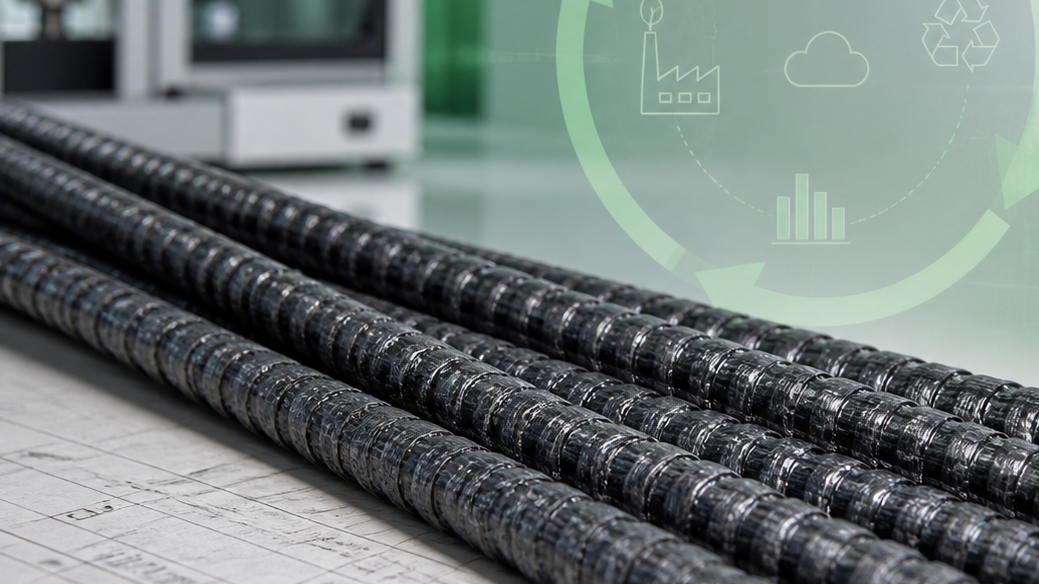
Known as NSF 1125-25, Fiber Reinforced Polymer Composite Products – Rebar or Dowel Bars, the rule addresses composite reinforcement used internally in concrete structures and infrastructure. It covers specified glass, basalt and carbon fiber-reinforced products, including straight and bent reinforcing bars and dowel bars.
What Is a Product Category Rule?
A Product Category Rule, or PCR, establishes the requirements manufacturers must follow when conducting a life-cycle assessment for a particular type of product.
The results can be published through an Environmental Product Declaration, commonly called an EPD. An EPD presents independently verified environmental information in a standardized format, allowing products within the same category to be evaluated using consistent methods.
The new FRP rebar PCR establishes requirements relating to the scope of the assessment, data collection, environmental calculations and reporting. It is intended primarily for North America but may also be used in other regions when accepted by the relevant EPD program operator.
According to the published document, the PCR was developed in accordance with ISO 14025:2006 and ISO 21930:2017 and is valid through August 31, 2030.
Supporting More Consistent Environmental Comparisons
Until now, the FRP rebar industry did not have a dedicated product category rule providing a common foundation for EPD development.
The new framework will allow manufacturers to produce more standardized and comparable environmental data for FRP reinforcement. This information can help civil engineers, architects, transportation agencies and infrastructure owners consider environmental impacts alongside structural performance, cost and expected service life.
The rule does not automatically declare that one reinforcement product is more sustainable than another. Instead, it defines how manufacturers should measure and report environmental impacts so that purchasing and specification decisions can be based on transparent information.
This distinction is important because the environmental performance of reinforcement depends on multiple factors, including raw materials, manufacturing energy, transportation, construction requirements, service life and end-of-life assumptions.
Why This Matters for FRP Rebar
FRP rebar is increasingly considered for concrete structures exposed to moisture, salt and aggressive chemicals. Unlike conventional steel reinforcement, FRP does not experience electrochemical corrosion.
This property can be particularly valuable in bridges, seawalls, parking structures, tunnels, industrial facilities and wastewater infrastructure. Preventing reinforcement corrosion may reduce the need for repairs and contribute to longer-lasting concrete structures.
FRP reinforcement is also lightweight, which can reduce handling demands and transportation weight. However, credible environmental comparisons require a complete life-cycle assessment rather than relying on a single product characteristic.
EPDs prepared under NSF 1125-25 can give project teams access to more comprehensive data when evaluating these potential benefits.
Industry Collaboration and Review
The PCR was developed with guidance from a technical committee of industry experts and underwent public comment and review. NSF served as the program operator, while development funding was provided through ACMA’s Composites Growth Initiative Fund.
ACMA described the completed rule as an important milestone for the composites sector, noting that standardized environmental reporting can help manufacturers respond to growing demand for transparency in infrastructure procurement.
The rule also references relevant technical specifications for composite reinforcement, including ASTM D7957/D7957M for solid round GFRP bars, ASTM D8444 for FRP dowel bars, ASTM D8505/D8505M for basalt and glass FRP bars, and CSA S807 for fiber-reinforced polymer materials.
Moving Toward Data-Driven Infrastructure Decisions
The completion of the FRP rebar PCR reflects a broader change in construction-material selection. Infrastructure owners increasingly expect suppliers to provide both engineering documentation and verifiable environmental information.
For FRP rebar manufacturers, the next step is to conduct product-specific life-cycle assessments and publish independently verified EPDs in accordance with the new rule.
As more declarations become available, designers and public agencies will be better positioned to compare reinforcement solutions using consistent environmental data. Combined with appropriate structural design, applicable building codes and verified material properties, this development could support more informed consideration of FRP rebar in durable concrete infrastructure.
The ACMA announcement and the complete NSF 1125-25 Product Category Rule are available online.