
September 3, 2025 — Geneva, Switzerland
The International Organization for Standardization has published ISO 10406-1:2025, the third edition of its international standard for testing fiber-reinforced polymer reinforcement used in concrete.
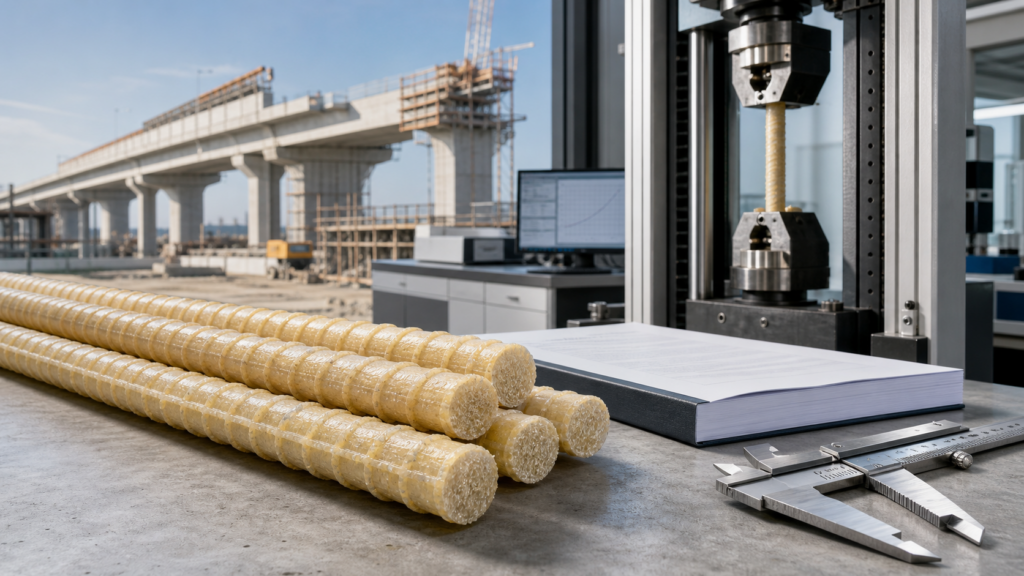
Titled Fibre-reinforced polymer (FRP) reinforcement of concrete — Test methods — Part 1: FRP bars, the updated standard provides test methods for determining the physical, mechanical, durability and long-term properties of FRP bars used as concrete reinforcement or prestressing tendons.
The new edition replaces ISO 10406-1:2015 and reflects continuing technical development in nonmetallic concrete reinforcement.
A Common Framework for Evaluating FRP Rebar
FRP rebar differs significantly from conventional steel reinforcement. Its performance depends on factors such as fiber type, resin matrix, manufacturing process, surface profile and exposure conditions. Consistent testing is therefore essential for comparing products and supplying engineers with reliable design data.
ISO 10406-1:2025 covers reinforcement manufactured with several types of fibers, including:
- Glass fiber, commonly used in GFRP rebar
- Basalt fiber
- Carbon fiber
- Aramid fiber
The standard also applies to products made with thermosetting resin systems, such as vinyl ester and unsaturated polyester, as well as specified thermoplastic matrices.
By establishing internationally recognized testing procedures, the standard can help laboratories and manufacturers evaluate FRP bars using a more consistent technical framework. It may also improve communication among material suppliers, engineers, certification organizations and infrastructure owners.
Supporting Quality and Long-Term Performance
FRP rebar is increasingly considered for structures exposed to moisture, chlorides and aggressive chemicals. Typical applications include bridges, seawalls, tunnels, parking structures, wastewater facilities and other concrete infrastructure where corrosion of conventional steel reinforcement can create substantial maintenance costs.
Unlike steel, FRP reinforcement is noncorrosive. It also offers a high strength-to-weight ratio and is considerably easier to transport and handle. However, its mechanical behavior is different from that of steel, making appropriate material testing and FRP-specific structural design essential.
The updated ISO standard does not independently approve a product for every construction project. Manufacturers and designers must still consider applicable national building codes, project specifications and other material standards. In the United States and Canada, for example, ISO testing may be used alongside relevant ACI, ASTM and CSA requirements.
A Step Forward for the FRP Rebar Industry
The publication of ISO 10406-1:2025 represents another step toward greater international consistency in the evaluation of composite reinforcement.
For FRP rebar manufacturers, the updated standard provides a current reference for demonstrating material performance. For engineers and owners, consistent test methods can make it easier to evaluate technical documentation and compare reinforcement products for demanding concrete applications.
As governments and infrastructure owners seek longer-lasting and more sustainable construction solutions, recognized testing standards will be important to the responsible adoption of GFRP and other FRP reinforcement systems.
The complete standard was published on September 2, 2025, and is available from the International Organization for Standardization.